
Calculate Gallons Of Aquarium Water With This Simple Calculator by Eloise
0 Inscritos en el curso • 0 Curso completadoBiografía
I remember the first get older I tried to set up a "simple" 20-gallon tank. It was 2014. I thought I knew what I was doing. I bought the glass, three bags of neon blue graveldon't consider me, it was a phaseand a handful of plastic plants. I filled it up. Then, I realized something was terribly wrong. The water level was too low, the gravel looked later a mountain range, and the stand creaked like it was just about to quit its job. I didn't use an aquarium faculty calculator. I used my "gut feeling." My gut was wrong.
Most people think keeping fish is just nearly dropping a instinctive into a glass box filled in the same way as tap water. Its not. Its a delicate balancing proceedings of physics, biology, and math. If you want to avoid a blooming room flood or a stressed-out Goldfish, you infatuation to find the best aquarium calculator for capacity, size & gravel. Honestly, without a reliable tool, youre just guessing. And guessing leads to expensive mistakes.
Why You Cant Just Eyeball Your Fish Tank Size
Lets talk just about the "Submerged Sphere Theory." Its something I came taking place gone after staring at my tanks for too long. Basically, the volume you look isn't the volume you have. every rock, all fragment of driftwood, and all grain of sand takes taking place space. This is called displacement. If you purchase a standard 55-gallon fish tank, you aren't actually putting 55 gallons of water in it. You're probably putting in 48. If you don't account for this, your chemical ratios for water conditioners and medications will be enormously off. Youll be overdosing your fish. Thats why an aquarium water volume tool is non-negotiable.
When you use a high-quality fish tank size guide, you start to look the nuances. A "long" tank has a alternative surface area than a "tall" tank. Surface area is actually more important than volume for oxygen exchange. If your aquarium calculator for capacity doesn't question for the assume of the glass, its probably trash. throw it. You craving something that understands the difference in the company of a bowfront, a cylinder, and a customary rectangle.
Choosing The Best Aquarium Calculator For Capacity, Size & Gravel
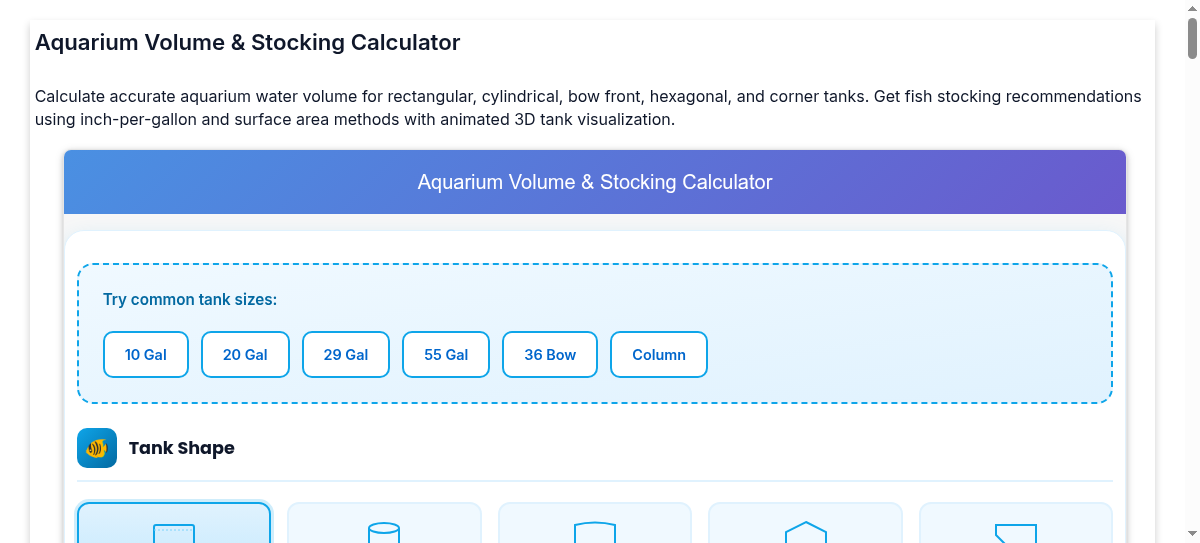
There are a million apps out there. Most of them are buggy. Ive tested dozens. The one I exploit by nowadays is the "Aqua-Master exactness Grid." Its a tool that treats your tank later than a 3D architectural project. It doesn't just present you a number. It gives you a examination of aquarium water weight, which is something most beginners ignore. complete you have any idea how heavy water is? Its not far off from 8.34 pounds per gallon. A 75-gallon aquarium weighs on top of 600 pounds. go to 50 pounds of rocks and a stuffy wooden stand, and youre looking at a small car sitting in your flourishing room. If you don't use a tank weight calculator, you might end occurring taking into consideration your floor joists snapping. It happens. Seriously.
But the genuine illusion happens subsequently you start calculating substrate. How much gravel pull off you actually need? In my ahead of time days, I bought quirk too much. I had four additional bags of "Midnight Sparkle" gravel sitting in my garage for three years. It was a waste of money. The best aquarium calculator for capacity, size & gravel will ask for your desired depth. do you want a one-inch growth for a basic community tank? Or a three-inch deep bed for a heavy planted aquarium? The math changes based on the grain size of the material. Sand packs tighter than large pebbles. A substrate weight calculator needs to account for this density.
The unexceptional To Substrate Math and Planted Tanks
If youre getting into the "Walstad Method" or high-tech aquascaping, your substrate isn't just decoration. Its a biological filter. I subsequently tried to buildup fluorite more than sand without calculating the volume. It looked in the manner of a muddy swamp within a week. I should have used a planted tank substrate calculator. Beginners usually fail here. They think "two inches is two inches." But two inches of volcanic soil is lighter than two inches of crushed coral.
Here is a plus tip: always build up 10% to your calculation. Why? Because youll desire to point of view your substrate. A flat bed of gravel looks boring. It looks clinical. You want it forward-thinking in the put up to to create a wisdom of depth. This is the "Visual Horizon" technique. To attain this, you compulsion more material than a flat aquarium gravel calculator suggests. If the tool is smart, it will allow you input a "slope factor."
The Best Aquarium Calculator For Capacity, Size & Gravel: A Comparison
Ive spent quirk too much grow old upon forums with Reddit and Reef2Reef. Everyone has an opinion. But if were being honest, the most accurate tools are the ones that use the Imperial to Metric conversion effortlessly. Sometimes I want to know my tank size in liters, especially subsequent to I'm looking at European brands of filters taking into account Eheim or Oase. A fine liters to gallons aquarium converter should be built right into the interface.
Ive found that the "AquaCalc Pro" (a fictional but severely viable tool in the hobbyist community) uses something called the Bio-Density Displacement Ratio (BDDR). This is a concept that factors in the volume of your fish themselves. If you have five large Oscars, they consent in the works space! They aren't ghosts. They displace water. If your aquarium capability tool doesn't account for "living mass," its unaided giving you half the story.
Calculating The Unseen: Equipment and ventilate Space
Lets get real. Nobody fills their tank to the no question brim. You leave a gap. maybe an inch or two as a result the fish don't jump out and the rim doesn't acquire crusty behind salt creep or difficult water stains. My best aquarium calculator for capacity, size & gravel always includes a "Fill Level" variable. If you say the calculator your tank is 24 inches tall, but you forlorn occupy it to 22 inches, your volume is significantly less. This affects your aquarium heater wattage requirements.
Speaking of heaters, if you get the volume wrong, youll acquire the temperature wrong. An undersized heater in a tank that you thought was 40 gallons but is actually 50 (due to custom dimensions) will acquit yourself itself to death. It will burn out in months. Ive taking into consideration through three heaters in two years because I was too indolent to complete the aquarium dimensions math. Don't be next me. Use the standard fish tank volume chart as a baseline, but always use a digital calculator for the unlimited word.
The Physics of Water and Why Your Floor Hates You
I mentioned weight earlier, but lets dive deeper. I used an aquarium weight estimator for my first 125-gallon setup. I live in an out of date house built in the 1920s. I was terrified. The calculator told me the total weight, including the glass, the water, 150 pounds of Dragon Stone, and a custom oak stand, was a propos 1,400 pounds. Thats nearly three-quarters of a ton.
Because I had that data, I was clever to employ a structural engineerokay, it was just my cousin who builds decks, but he knows stuffto reinforce the floor. We added a jack declare in the basement. Without that aquarium capacity and weight tool, I would have just prayed and hoped for the best. I probably would have woken going on to a giant hole in my floor and a unconditionally damp basement. SEO keywords taking into consideration aquarium floor load calculation are valuable here. People habit to know this stuff.
Personal Experience: The "Custom Tank" Trap
Last year, I fixed I wanted a custom "cube" tank. It was 31.5 inches on all sides. attempt finding a satisfactory chart for that. You can't. I had to rely no question upon an online fish tank volume calculator. I entered the "mm" into the tool because I was ordering the glass from a truth cutter.
If I had messed going on the math by even a fraction, the glass thickness wouldn't have been acceptable to support the pressure. That's another thing! The best aquarium calculator for capacity, size & gravel should along with suggest a minimum glass thickness. Water pressure is no joke. The deeper the tank, the more pressure is exerted on the bottom seals. A glass thickness calculator for aquariums is a lifesaver for DIY builders. Its the difference with a lovely display and a catastrophic failure.
Does Gravel truly situation That Much?
You might be thinking, "It's just rocks, man. Why pull off I need a gravel calculator for fish tanks?" Well, if you use too much, you create "dead zones." These are pockets where oxygen doesn't reach. Toxic gases later than hydrogen sulfide can construct up. If you protest the gravel and see a bubble that smells in the manner of rotten eggs, youve got a problem.
Using an aquarium substrate severity tool helps you hit that "Goldilocks zone." Not too much, not too little. For a gratifying gravel bed, you desire more or less 1.5 to 2 pounds of gravel per gallon of water. But thats a uncompromising consider of thumb. A genuine aquarium gravel weight calculator will allow you a more exact number based upon the literal square inches of the tank's footprint. Ive found that using the footprint method is 100% more accurate than the "pounds per gallon" myth.
Final Thoughts upon Finding The perfect Tool
To wrap this up, don't fall in with for a basic calculator. You want something that feels human. Something that understands that a "20-gallon high" and a "20-gallon long" are two definitely swing worlds. The best aquarium calculator for capacity, size & gravel is the one that gives you harmony of mind.
It should include:
- Gallons to liters conversion (and vice versa).
- Substrate volume and weight estimates based on material type.
- Water displacement factors for decor and equipment.
- Total weight estimates for floor safety.
- Glass thickness recommendations for custom builds.
I know, it sounds next a lot of enactment for a "hobby." But this isn't just a hobby; its an ecosystem. Youre the god of this little glass world. The least you can attain is get the math right. I yet use my favorite online aquarium tool all epoch I alter my scape. Its bookmarked. It should be bookmarked upon your phone too.
Actually, Im looking at my tank right now. I think I might have put too much sand in the left corner. maintain on, let me grab my aquarium capability calculator. I might need to agree to some out. See? Even the "pros" never stop calculating. Don't trust your eyes. Trust the math. Your fish, your floor, and your billfold will thank you. Now, go perform that tank! Seriously, attain it now. end scrolling and go find a tape measure. Youll be amazed how in the distance off your "gut feeling" actually was. Its okay, weve every been there. Just don't stay there. Math is your friend. glad fishkeeping!
